We thought we had all the time in the world.
We were young. We were healthy. Nothing was urgent. Then, in the space of a few months, my partner had a stroke — and everything I thought I knew about time, control, and what matters rearranged itself completely.
I'm not writing this for sympathy. I'm writing it because that period left marks — the stroke, then losing my job while she was still in recovery, then an economic shockwave from across the Atlantic pulling investment out of Germany and taking the stability I'd rebuilt with it. Three different kinds of collapse, landing close together. What they had in common wasn't a cause. It was a feeling: things I'd taken for granted turning out to be fragile in ways I hadn't examined.
This is that examination. Articles 01 and 02 looked at it from the outside — policy, infrastructure, Europe rebuilding its systems. This one is from the inside. What a person actually does when the ground shifts. What gets rebuilt, and how, and why.
The thing about mortality.
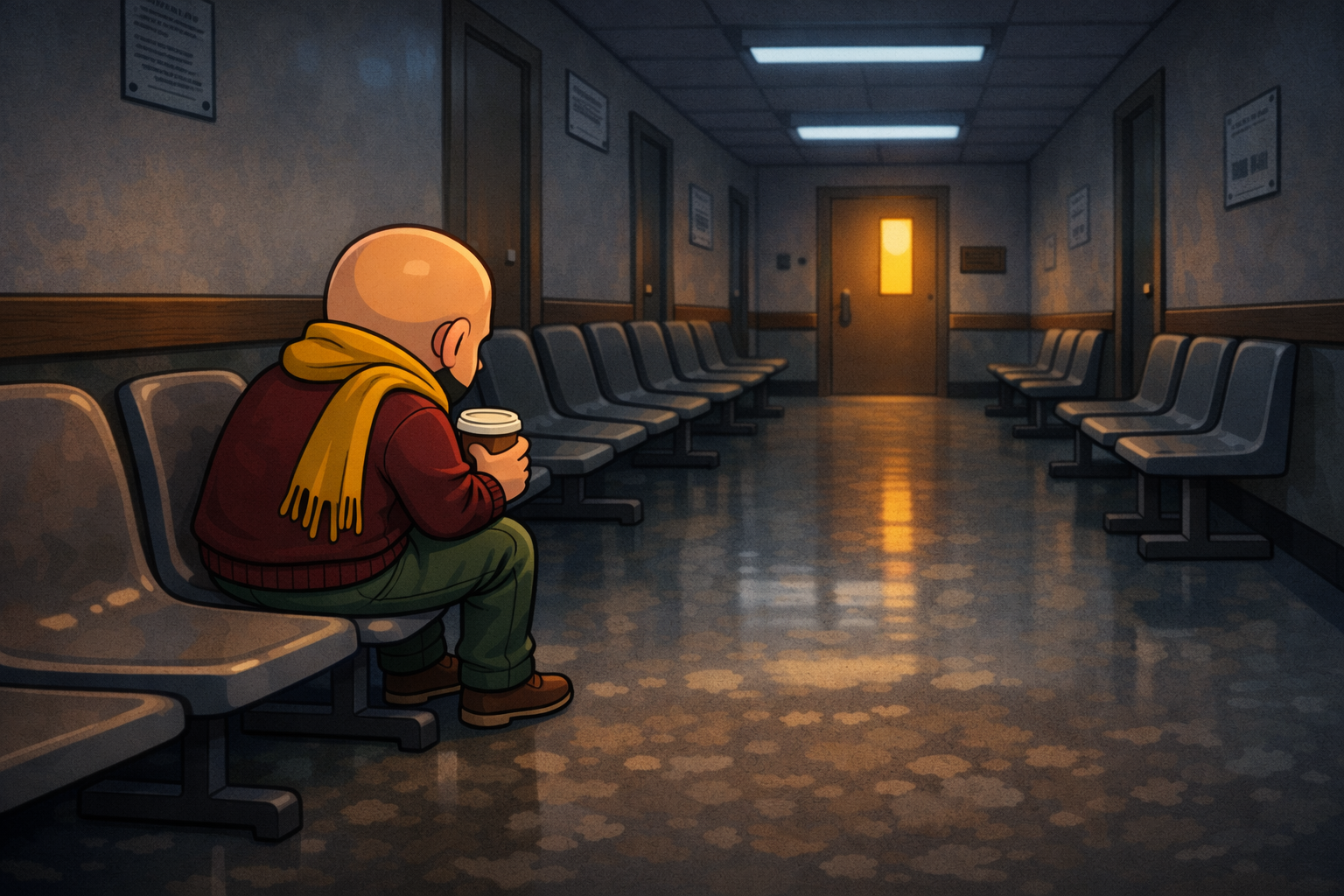
There's a specific kind of awakening that happens when someone you love nearly dies. It's not poetic. It's not a montage. It's sitting in a hospital corridor at 2am watching a door, understanding for the first time in a visceral way that you are mortal, that the people you love are mortal, and that the things you've been postponing don't have a guaranteed tomorrow.
What followed was a recalibration that touched everything. How we eat — we went fully plant-based, not as ideology but as the most immediate and concrete thing we could do for health, for longevity, for the planet our decisions are part of. How we move — I got certified in massage, not to start a business, but because my partner needed care and I wanted to give it properly, with knowledge, not just intention. How we spend time — with the dog on morning walks, which turned out to be one of the most important practices in the day. Not productivity. Just presence.
Empathy isn't soft. It's the most rational response to understanding that everyone around you is carrying something — and that the systems we build either help people carry it or make it heavier.
Solarpunk is not a mood board.
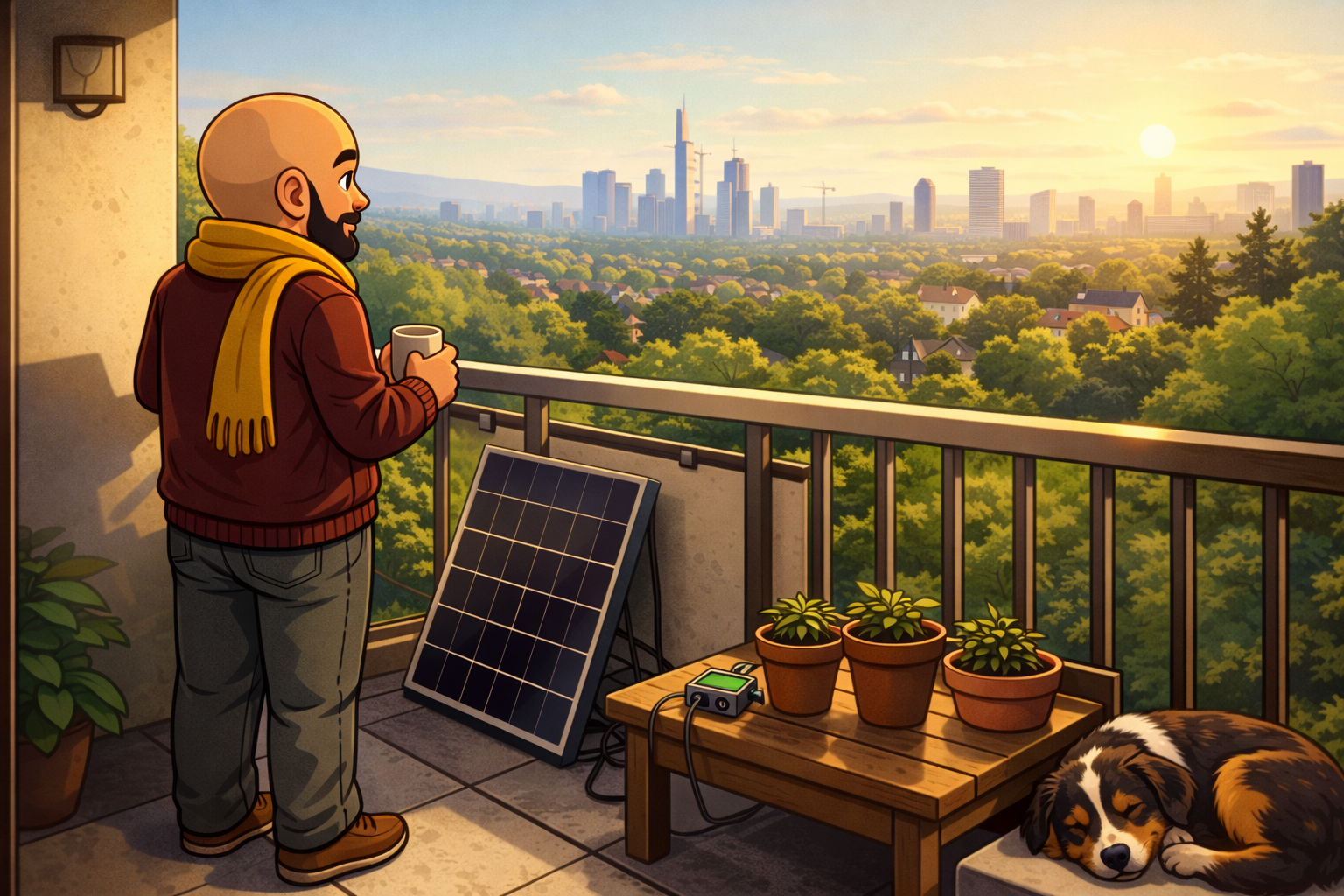
Solarpunk gets misunderstood constantly. People see the imagery — the green rooftops, the community gardens, the solar panels woven into organic architecture — and file it as aesthetic. A vibe. Something for Instagram.
That's not what it is. Solarpunk is an operational philosophy. It's the argument that the future doesn't have to be dystopian — that the alternative to corporate centralisation and ecological collapse isn't primitive withdrawal but intentional, technological, community-rooted building. It says: you don't need permission to start. You begin with what you have, where you are, and you build in the direction of the world you want.
This is why the EU infrastructure story from Article 02 matters beyond policy. SMRs distributed across member states, open-source European cloud alternatives, a digital euro that removes the American intermediary from European payments — these are solarpunk ideas operating at continental scale. Decentralise the energy. Own the rails. Build what you need rather than rent it indefinitely from someone whose interests don't align with yours.
And if you can do it at continental scale, you can do it at personal scale. The logic is identical. The tools are just smaller.
What a personal sovereign system actually looks like.
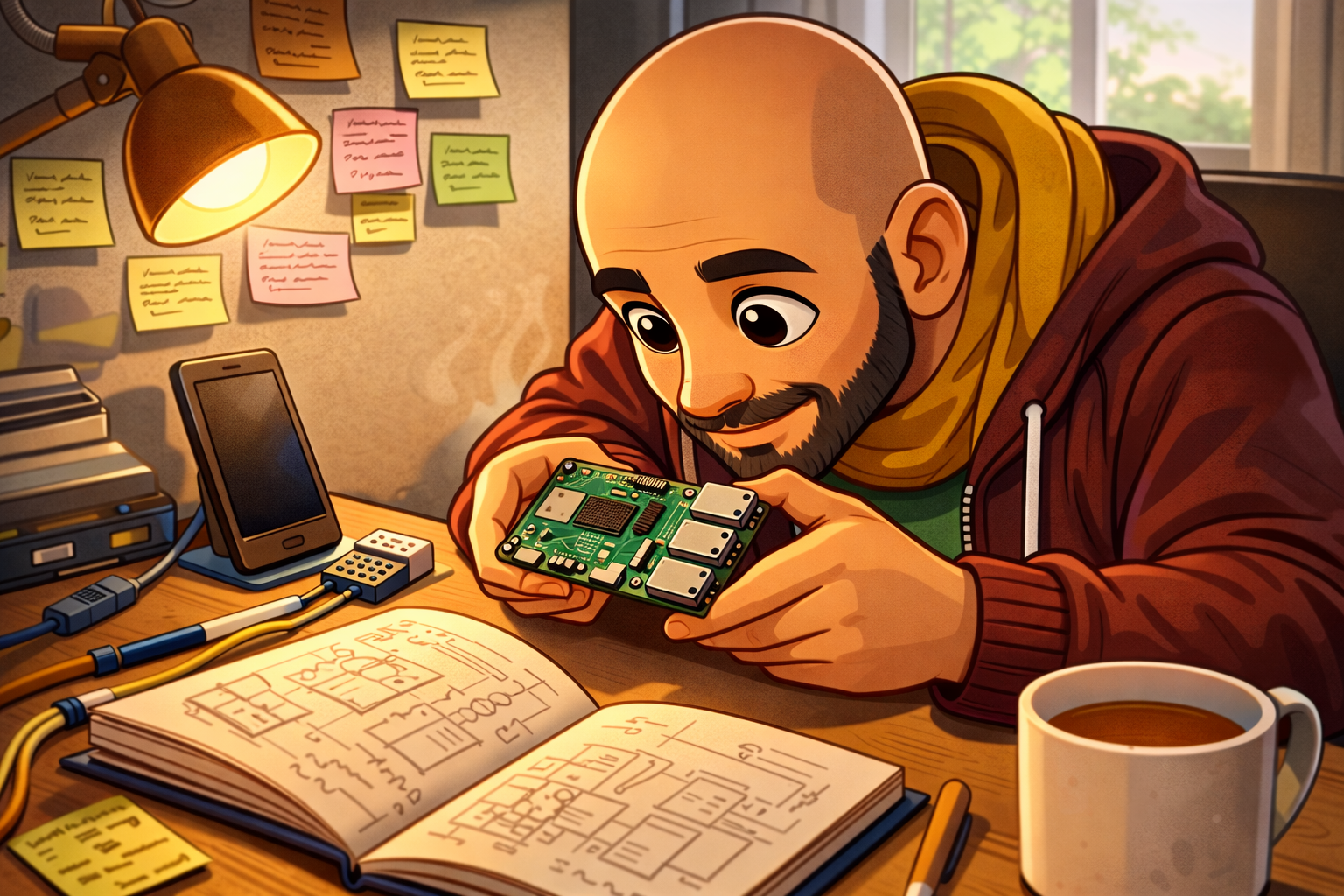
I want to be honest about where I am with this. I have a drawer full of old hardware and a clear vision and a list of things I haven't built yet. This isn't a success story — it's a work in progress with a direction. The goal isn't to arrive at some perfect off-grid state. The goal is to move, consistently, toward less dependency and more intentional control — one layer at a time.
None of this requires a large budget or a computer science degree. It requires patience, curiosity, and the willingness to learn in public. Reuse, repurpose, recycle isn't a slogan here. It's the operating principle. The most sustainable piece of hardware is the one that already exists.
An old Android phone running Termux, a laptop that still boots, a Pi from a few years ago — all of these can host a blog, a weather node, a personal data layer. The sunk cost is paid. Running these devices for useful work is the closest consumer electronics gets to a closed loop.
Control yourself. Control your reality.
That phrase sounds like self-help. It isn't. It's something more specific: once you've felt what uncontrolled fragility actually feels like — in a hospital, in your own body, in your family — you start noticing it everywhere you'd previously ignored it. Not because the same force caused all of it. But because that kind of experience changes your sensitivity. You stop taking stability for granted. You start asking: what am I depending on here, how stable is it actually, and have I ever chosen it — or did I just drift into it?
That question, applied consistently, is uncomfortable. It turns out an enormous amount of daily life runs on infrastructure that was never chosen consciously. The platforms where your communication lives. The algorithm deciding what you read. The energy that arrives from somewhere you've never thought about. The payment rails owned by companies you've never agreed with. Most people don't examine any of this until something forces the question. I got forced. And once I started looking, I couldn't stop.
I'm not arguing for isolation. I'm arguing for intentional architecture. Understanding which dependencies are acceptable — because they offer genuine value and the tradeoff is fair — and which ones are just the default, never examined, never chosen, just inherited from convenience.
Veganism is part of this for me, but it started somewhere more personal than politics. After the stroke, after months of being acutely focused on health, on what we put into our bodies, on what we can and can't control — the food we eat became one of the clearest expressions of the values we were consciously choosing. Care for each other. Care for the planet that our decisions are part of. It wasn't a manifesto moment. It was a quiet, practical one. And it turns out to also be one of the most direct individual levers on emissions — which matters to me too, separately, for its own reasons.
The morning walk with the dog is part of this too — not in a grand philosophical way, just as the daily practice of being present in a body, in a neighbourhood, in a community that is physically real rather than algorithmically curated. It grounds things. It matters more than it sounds.
Convenient. Someone else's terms.
- Your content lives on their platform
- Your data trains their models
- Your information filtered by their algorithm
- Your energy bought from their centralised grid
- Their terms change without asking you
- Change happens to you, not with you
More effort. Your terms.
- Your content on your server, your domain
- Your data stays on your hardware
- Your information from sources you chose
- Your energy partially generated locally
- You own the configuration
- You participate in shaping what changes
Define. Design. Develop. Applied to a life.
Not what you're supposed to value. Not what the career ladder or the default life script suggests you should want. What you actually, genuinely, after all the difficulty, find worth protecting. For me that turned out to be: health, presence, honest relationships, the capacity to contribute to something beyond my own career. Everything else is negotiable.
Not all at once. Not perfectly from the start. The plant-based diet didn't require a lecture — it required a decision and a week of learning to cook differently. The massage certification didn't require a career change — a course and the intention to use it. The home server doesn't require a new machine — it might already be in the drawer. Design with what exists.
This blog is part of that. Sharing the research, the thinking, the things that aren't finished yet. The goal isn't to present a complete life philosophy — it's to think out loud with people asking the same questions, and to build something together that's more useful than either of us would build alone. That's what community is for.
That's where this blog is right now. The philosophy is clear. The architecture is mapped. The builds are in progress — some done, some planned, some still just a drawer of hardware and a list of questions. I'll document all of it here as it develops: the self-hosted server, the sensor nodes, the solar numbers, the things that break and the things that surprise me. The honest version, not the retrospective success story.
I find a lot of things worth writing about — the EU policy shifts from Articles 01 and 02, the practical technology that makes sovereignty possible at personal scale, the design and communication questions that connect all of it. There will be more.
Once the RSS feed and email subscription are running — which is one of the first things I'm building — you'll be able to follow along properly. No algorithm between us. No platform deciding whether you see the next post. Just a direct line, whenever something new exists worth reading. I'll let you know when it's ready.
Fact-Check — Claims Verified
| Verdict | Claim & Notes |
|---|---|
| FALSE | "Solarpunk is just an aesthetic." Solarpunk originated as a literary and political movement in the early 2010s — a direct response to cyberpunk's corporate dystopia. The visual language is an expression of the philosophy, not its substance. It argues for decentralised, community-rooted, ecologically embedded technology as a genuine alternative to corporate centralisation. Sources: A Solarpunk Manifesto (2014, revised 2019); Sunvault: Stories of Solarpunk and Eco-Speculation (2017). |
| FALSE | "Individual choices don't matter at systemic scale." Animal agriculture accounts for approximately 14.5% of global greenhouse gas emissions (UN FAO). A plant-based diet reduces an individual's food-related carbon footprint by approximately 73% versus a meat-heavy diet. This doesn't replace systemic change — it runs alongside it. Sources: FAO, Tackling Climate Change Through Livestock (2013); Poore & Nemecek, Science (2018). |
| FALSE | "Self-hosting requires technical expertise most people don't have." A Raspberry Pi with a pre-built image (DietPi, YunoHost) can be configured by a non-developer in an afternoon. Termux on an old Android phone requires no root access and no prior Linux knowledge. The barrier is time and willingness, not expertise. Sources: yunohost.org, termux.dev |
| CONFIRMED | "Europe's infrastructure shift is a solarpunk idea at scale." The EU SMR strategy (March 2026), the Digital Euro project, the Cloud and AI Development Act, and Gaia-X all follow the same logic: decentralise generation, own the rails, reduce dependency on external actors. Whether or not the EU uses the word, the architecture is identical. See Article 02 on this blog for primary sources. |
| NUANCED | "Decentralisation always produces better outcomes." Decentralisation reduces certain failure modes — single points of control, censorship, platform capture — while introducing others: coordination costs, interoperability problems. The argument isn't that decentralised is always better. It's that the current default is so heavily centralised that most people have no resilience when a central node fails. The goal is balance, not maximum fragmentation. |
| CONFIRMED | "A Raspberry Pi can run on solar power in Germany." Average draw of a Pi 4 at moderate load: 5–7W. A 30W panel in Frankfurt/Rhine-Main produces approximately 120–140 kWh/year at standard installation angles (PVGIS data, European Commission). This sustains continuous Pi operation from April through September with a small LiFePO4 buffer. Winter requires supplementary grid power. Source: EC PVGIS Tool. |
- UN Food and Agriculture Organization — Tackling Climate Change Through Livestock (2013): fao.org
- Poore & Nemecek — "Reducing food's environmental impacts," Science Vol. 360 (2018): science.org
- A Solarpunk Manifesto (2014, revised 2019): re-des.org
- European Commission PVGIS Tool — solar yield data, Rhine-Main region: re.jrc.ec.europa.eu
- YunoHost — self-hosting made accessible: yunohost.org
- DietPi — lightweight OS for single-board computers: dietpi.com
- Termux — Linux environment on Android without root: termux.dev
- Meshtastic — open-source decentralised mesh networking: meshtastic.org
Personal perspective. The philosophy here is my own, drawn from lived experience and ongoing reading. The facts are verified to the best of my ability — sources listed above. If you find an error, tell me. That's how this works.
I work with local companies, founders, and independents who care about doing things properly. Not the fastest, not the cheapest, not the most scalable. The most honest. If that's you, I'd genuinely love to hear what you're working on. No pitch deck. No discovery call. Just a real conversation.